
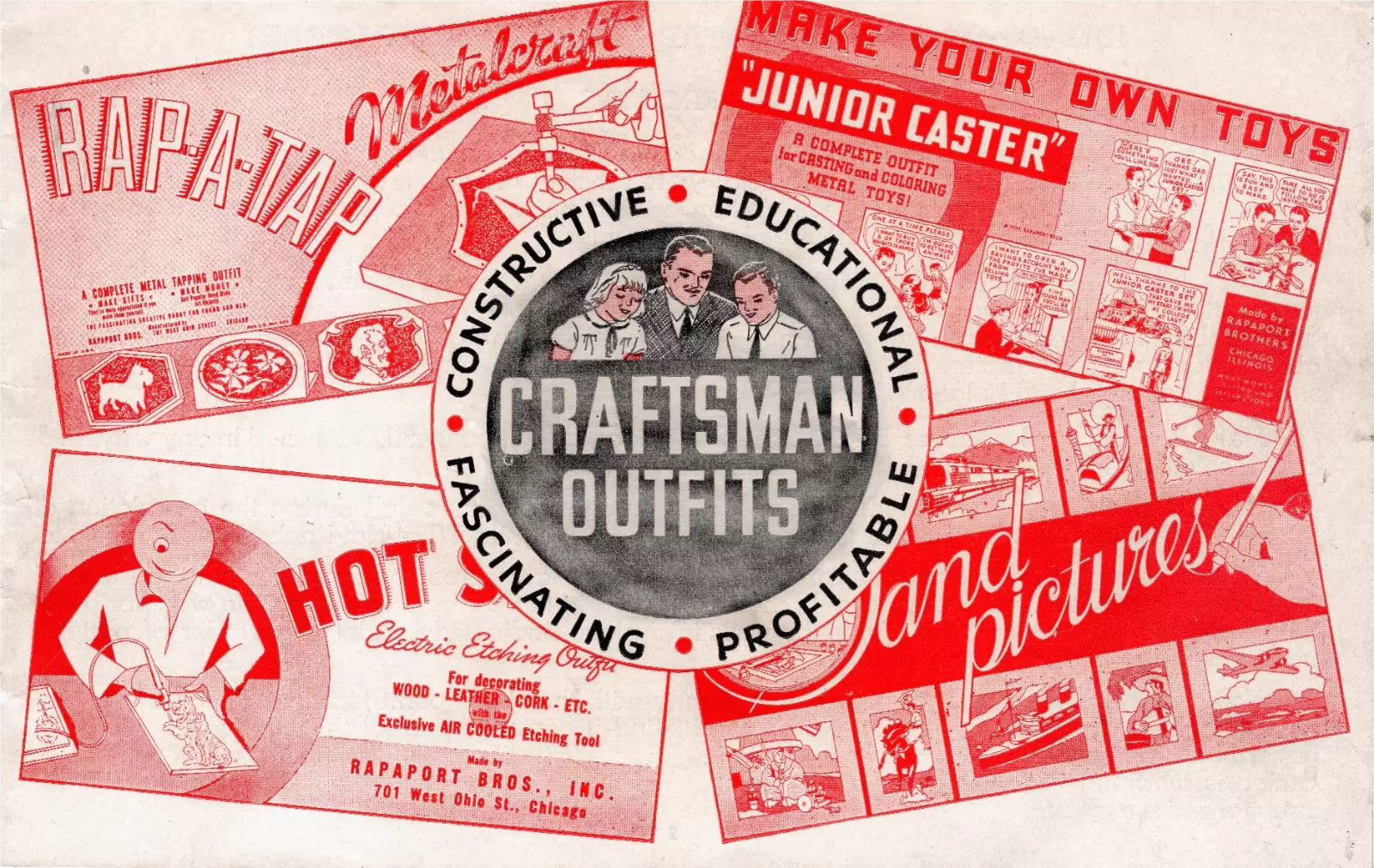
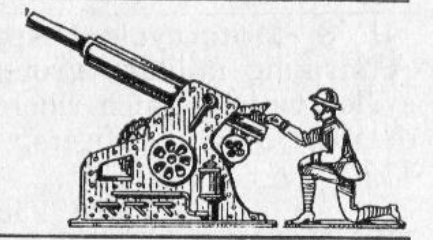
It is believed that Rapaport Bros., an American company, got it start about 1930 when the five Rapaport Brothers (possibly german), using designs from the German Schneider/Schierke designs as well as designs they created themselves started Junior Caster. Some of the designs they copied from the Germans include Schiff, and Ganseliesel, while original designs in the 1930 catalog include Battlecruiser, an anti-aircraft gun (which was then copied by A.C. Gilbert) and The Dirigble. 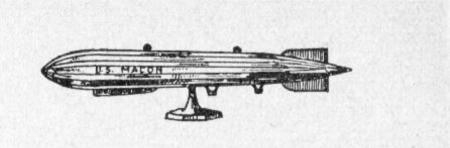 Around 1935 advertisements for the Buck Rogers series of models appeared. Consisting of eight moulds, one of which is the holy grail as only models have been found-no mould. Additionally, there is one mould number, E-2508, that was set aside but neither mould nor model has ever been located.
In 1935 The Home Foundry company was started. Home Foundry was almost certainly a company also owned by the Rapaport brothers. The moulds from this company were almost entirely original designs, with the models much more action oriented. The 1937 catalog added a machine gunner, as well as Popeye Designs, Mickey Mouse and Flash Gordon.
As was bound to happen with five brothers running a company together, arguments ensued and prior to WWII the company was broken up. One brother went into business as American Toy and Furniture Company and produced the comic patterns under the Ever-Ready brand. These patterns were apparently destroyed as WWII started and American Toy failed to survive WWII.
The other company became Rapaport Bros., keeping the rest of the patterns and mould inventory. Once the war got under way it was almost impossible to produce and sell moulds as the metal was needed for the war and simply not availabe for home use. Following the war Home Foundry started selling the Rapaport Bros., line of moulds, as well as many new moulds.
 In 1965 Martin Yale Industries Inc., of Chicago bought out the remaining Rapaport Bros., and became RAPCO, Inc. These moulds were sold thru a variety of names including RAPCO, Cast Rite, and Home Foundry. Additionally, Sears and Montgomery Wards (remember them?) got into the action repackaging the moulds under their label.
By 1969 it was becoming clear that children melting lead on the kitchen stove, and playing with lead models was probably not the best use of lead. By the 1970's lead toys were being banned in both the US and Europe, Thus bringing down RAPCO.
In the early 1970's Bert Dunken, remembering his childhood casting toys, reached out to RAPCO/Yale and ended up purchasing much of their inventory. Bert began Dunken Co., and started selling these moulds as "adult" models thereby bypassing the whole issue of children playing with lead.
In 1974 Bob Blanc, who was a Sales and Product Development manager with RAPCO left the company and started REB Toys. He then purchased RAPCO's entire tooling and mould inventory and founded Castings Inc., starting out in Illinois, then moving to Longwood Florida, and finally to Washington state. He restarted the production of the metal moulds (using zymac alloy) using the original Rapaport Brothers patterns. Bob expanded the company offerings with silicone rubber moulds of fully round models of both humans and animals, with the humans being approximately 1/32 scale.
Sadly the REB/Castings website no longer exists. The good news however is Dunken Co. appears to have at least the inventory from REB Toys if not the actual patterns.
Comments